
The wind-powered masts will be trialled later in 2021 and could become a part of the Shared Rural Network and help Vodafone meet its net zero targets in the UK.
- Vodafone is working with Crossflow Energy and Cornerstone to deploy Eco-Towers – reliable, self-powered mobile masts.
- Trial deployment will start later in 2021.
- The unique self-powered design enables new sites to be built in the most remote parts of the UK without the major challenge and cost of connecting to the electricity grid, supporting the industry commitment to cover 95% of the UK landmass by 2025.
- Eco-Tower deployment will also support Vodafone’s target of achieving net zero for its UK operations by 2027.
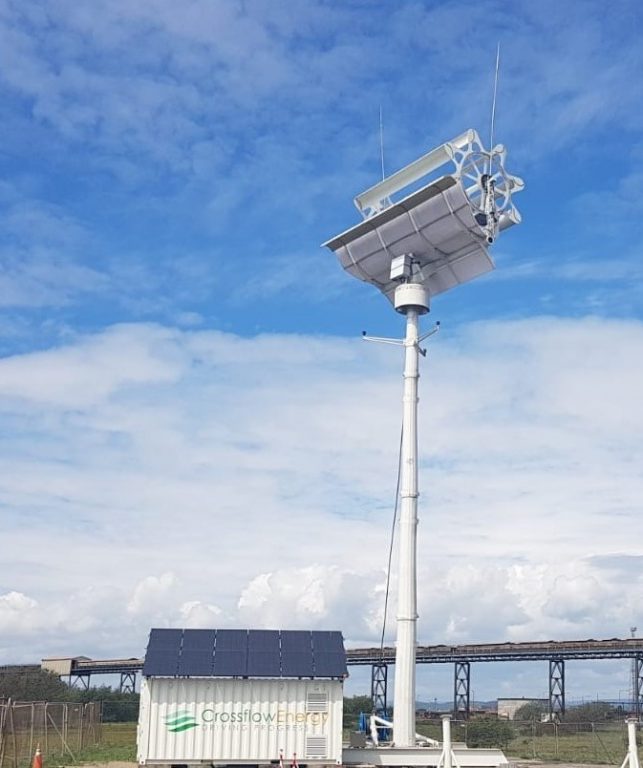
Vodafone has developed self-powered mobile towers and will deploy these across the UK, supporting the company’s target of achieving net-zero for its UK operations by 2027. The ground-breaking Eco-Towers will also enable the deployment of new mobile sites in the most remote locations, without the major challenge and cost of connecting to the electricity grid.
For the last two years, Vodafone and Crossflow Energy have been collaborating on the development of Crossflow Energy’s innovative wind turbine technology, combined with the latest in solar and battery technologies, to create a self-powered mobile network tower. Vodafone, alongside network partner Cornerstone, will now run a proof of concept to install Crossflow Turbine technology on rural mobile sites.
Vodafone is committed to working with industry partners to expand mobile coverage to reach 95% of the UK landmass by 2025 and achieve net-zero for its UK operations by 2027. As such, the adoption of innovative technologies, like the self-powered site, is essential to meeting both of these bold ambitions.
As well as reducing Vodafone’s energy consumption, self-powered sites remove the need to connect to the electricity grid, overcoming what can be an insurmountable civil engineering challenge when building new sites in the most rural parts of the UK. Further benefits of the Eco-Towers include:
- Using locally-generated renewable power reduces the environmental impact of the site.
- Increased renewable contribution from the combination of wind and solar, together with battery storage systems on-site, removes reliance on diesel generators for back-up power.
- Quiet, bird-friendly turbine makes the Eco-Tower viable for the most sensitive of sites, including Areas of Outstanding Natural Beauty.
- The security of the power supply is improved as the on-site power generation is independent from the electricity grid.
Andrea Dona, Chief Network Officer, Vodafone UK, said: “We are committed to improving rural connectivity, but this comes with some very significant challenges. Connecting masts to the energy grid can be a major barrier to delivering this objective, so making these sites self-sufficient is a huge step forward for us and for the mobile industry.
“Our approach to managing our network as responsibly as possible is very simple: we put sustainability at the heart of every decision. There is no silver bullet to reducing energy consumption, but each of these steps forward takes us closer to achieving net-zero for our UK operations by 2027.”
Martin Barnes, Chief Executive Officer, Crossflow Energy said: “We are really excited to be working with Vodafone. It’s a fantastic opportunity to show how our self-powered Eco-Tower solves the problem of harnessing ‘small wind’ to offer not just that all-important carbon reduction, but also significant commercial benefits. In the case of Vodafone, it will help to accelerate the expansion of rural connectivity, transform energy consumption patterns and deliver significant economic and carbon savings.
“Our turbine technology has equally strong applications for so many other industries, but to have such a high-profile player as Vodafone deploying our Eco-Tower is a major endorsement for us and our technology.”
Rhys Phillip, Chief Executive Officer, Cornerstone said: “Cornerstone is committed to sustainability and safeguarding the future of our planet. Piloting exciting initiatives like this with our partners and customers can only help us develop better ways of contributing to a sustainable, net-zero-carbon-emission future while ensuring a connected Britain.”
An incremental approach to network and operational efficiency
Vodafone UK will reach net-zero operations by 2027. Globally, across 21 countries, Vodafone will halve emissions in its supply chain by 2030, before reaching net-zero across its full value chain by 2040.
In April 2021, Vodafone and Ericsson began a trial using drones and Lidar-based 3D technology. With drones collecting high-definition imagery and Lidar technology collecting data to help build 3D digital twin models, only specialist operators need to travel to sites for surveys. With the imagery and 3D digital twin, radio engineers and network design teams can work in a virtual environment, saving time and money, speeding up network deployment across the UK, while also helping Vodafone reduce its carbon footprint.
In September 2021, Vodafone announced it would begin to deploy a new 5G radio unit which is 43% more energy efficient than the legacy equivalent. The new radio will help decrease the forecast energy consumption of the future 5G network once deployed.
Vodafone is committed to delivering connectivity services in the most responsible and sustainable manner. We confirmed earlier this year that our entire European business and network is now powered by 100% renewable electricity.


