
Transitioning to the new way of working
With each passing decade, we are seeing new eras of computing. The 1980s introduced us to the common PC; the 90s brought us emails, online shopping and the full force of the internet; and the 2000s saw the rise in social media, web 2.0 and introduced a new paradigm in the way that people connect.
Now, as we move through the 2020s, it’s clear that mobile computing and 5G will become a defining feature. Smartphones have developed exponentially since their inception, and the smartphone-using population is forecast to continue to grow steadily, with 5.9 billion devices in use by 2025 (or 71% of the total population of the planet).
Whilst the increase may come as no surprise, we are seeing faster and more powerful phones overtaking the supercomputers of yesteryear. As a result, the requirement to blend professional and personal activities into one is being credited as one of the main reasons for the innovation of such devices. The next step now comes with the transition into ‘mobile only’ working. According to a Frost & Sullivan study, mobile devices boost worker productivity by 34%, saving employees, on average, two hours per day equally split up between work and personal tasks.
This next shift is already underway. Many businesses that have migrated some or all of their tasks to mobile devices are reaping huge productivity gains, maintaining 24/7 connectivity, and enabling employees to serve partners and customers in real-time and, at the right time. This is helping to give business leaders that crucial edge that they need to stay ahead of the competition.
At the same time on the other side, it’s causing enterprises that were behind the technology trend, to fall even further behind and lead themselves into the risk of becoming obsolete. So, companies that are looking to stay updated into the future need to look at their existing infrastructure and decide when to bring in such a mobile-focus environment.
Reasons to go mobile:

Workforces shifting to mobile working – Over the last decade, we’ve seen shifts to flexible and remote working, and with the Covid pandemic over the last year or so, this transition has been spurred even further.

Employees preferring mobiles – With more people on their phones daily, why not take advantage of this and enable them to be able to do their work at the same time. The majority of roles have the ability to get at least half of their work done just from their mobile devices.
Investment in enterprise mobility – Smartphones and tablets have been utilised by most companies for many years now. Chances are your company has already adapted and supports enterprise mobility in a major way. This can include investing in mobile devices, MDM software, apps and processes and as such, already has an infrastructure in place to support such mobile working.
Supporting both PCs and smartphones is difficult on budgets and resources – Managing a mobile fleet alongside a computing fleet can be a great strain – but not if the mobiles themselves can essentially replace the computing infrastructure. Most business tasks can now be done on a mobile device so there is little need for a full desktop or laptop set up separate from the singular device.

There have been great advancements in mobile technology – Mobile technologies have advanced to the point of us not needing separate computing systems. Processing power, storage, screen size, all these things combined with the fact that mobiles are often updated more often than PCs, you’re probably in ‘better hands with your mobile’.

Business apps are increasingly cloud-based – With the rise of mobiles has also come to the increase in cloud-based apps, especially those optimised for business. Storing apps and data in a central cloud is also easier to secure and update.
Samsung DeX
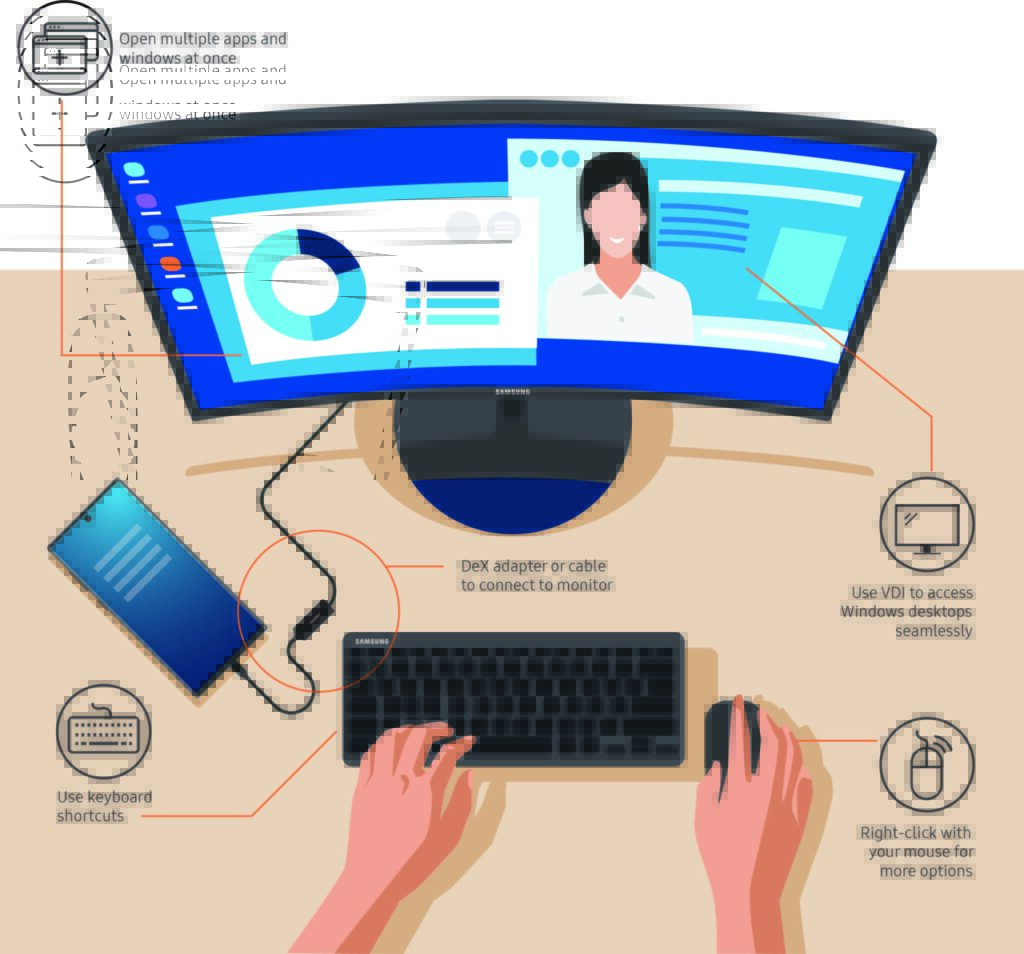
Having one piece of technology that connects everything benefits both your team and your business at large. Use a single device, with instant access to whatever you need, plus the chance for employees to personalise the device to their means.
In industries like public safety, DeX is even being leveraged in-vehicle to replace rugged laptops that remain bolted into the vehicle. It can also be used to power rugged mobile command centres at an emergency scene.
DeX also comes with security benefits. Samsung smartphones and tablets are protected by advanced biometric security and Samsung Knox. The defence-grade security platform protects devices from the chip up — from the moment they’re powered on — so you can be sure your information is safe.
Knox also gives you access to powerful management tools to maintain control of your company devices and enable your own security protocols. Since DeX is powered by a mobile device, it benefits from all these protections. Fewer devices mean a reduced attack surface for hackers.
Mobile computing is already transforming productivity across diverse industries, and businesses of all sizes will want to get on board sooner rather than later. Samsung DeX gives you a ready-made solution with reliable security built-in.


